Batch three having a brief layover in stainless.

White whiskey?

Posted August 29, 2012 by your friendly neighborhood distillers

Tags:

In the United States, all whiskey has to be aged. However, since it’s the law, there is of course an exception, which is corn whiskey; for whatever reason, that can be sold straight from the still. Corn whiskey is similar to bourbon mash, but instead of 51% corn, it has to be 80% corn. Since we are currently using about 57% corn in our bourbon mash, we are – if my math checks out, here – 23% short, so we’re going have to age our spirits before we can call them whiskey. But that’s alright, since there’s another loophole. This aging only has to be nominal; the whiskey just has to spend some time in a barrel – ten seconds will do. The barrel can be used, and it can be re-used indefinitely, batch after batch after batch. Anything that could impart some sort of barrel-aged character can be long dead, stripped out after years of being soaked in bourbon (or rye, or fish sauce, or whatever). The barrel merely serves as a way-point between the still and the bottle. For all intents and purposes, when “aging” whiskey like this, it will actually be unaged, or new make whiskey.

So, that’s what we’ll be doing.

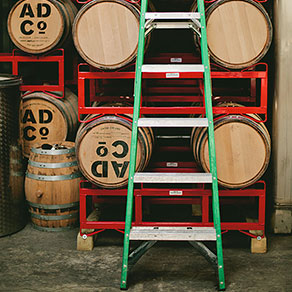
Right now, we are in the middle of batch three. We’re doing it as a “double” batch – that is, two identical mashes blended together. Batch three – like all our whiskey – is primarily destined for barrels, and will be the first batch available on the market (the fate of batches one and two is still up in the air). We’re going to fill six small (ten gallon) barrels with our third batch, and although we’ve still got one more run to go, we’ll definitely end up with more than 60 gallons – probably something closer to 70. Anything that does not fit neatly into the barrels gets poured down the drain will become new make.

Batch three having a brief layover in stainless.

Batch three having a brief layover in stainless steel tanks.

For those among you who are not whiskey nerds (which is probably very few, if you’ve read this far), new make whiskey is probably unlike anything you’ve ever had before. It’s really only been available commercially on any significant scale for the past few years, and doesn’t even have a  federal “type” designation (like bourbon, rye, Irish, etc.) yet – people call it white dog, white lightning, moonshine*, and so on. It has a taste that people aren’t used to; I liken it to tequila; it is similar in that it carries over a lot of the flavor of the original distillate, and makes a great flavor addition to shake into cocktails. In the case of tequila, the flavor that carries through is the agave plant; in the case of our bourbon mash, it is corn and rye. The similarities continue, but essentially in reverse: tequila can be bottled either unaged (blanco), aged between two months and a year (reposado), aged one to three years (añejo), or aged more than three years (extra añejo). Aging must be done in oak barrels (however, as with scotch, used barrels and artificial coloring are allowed – so color doesn’t necessarily indicate age). High-quailty aged tequilas will have a similar character to an aged whiskey; this is due, of course, to the barrel (I’ll talk about barrels in a future post). The difference comes in the presentation: people are generally presented with – and are accustomed to drinking – blanco tequila, and don’t often order an extra añejo. They are used to how it tastes, they are familiar with good ways to mix it, and they know if they want salt on the rim or not. With similarly aged whiskeys, however, this is nowhere near the case. People expect whiskey to taste a certain way, when in fact a lot of what they are tasting is not whiskey, but the oak barrel it’s been stored in.

White whiskey has gotten a lot of press, recently; some people like it, and some people hate it – but hating things makes for a more interesting news article, so I encourage you to try it for yourself. It’s pretty tasty stuff, though it might take a bit of getting used to – just like any other whiskey.


At any rate, here are the stats for batch 3:
Corn – 900 lbs.
Rye – 300 lbs.
Malted rye – 100 lbs.
Malted barley – 300 lbs.


*it’s not moonshine. I’m going to stop complaining about this someday, but moonshine = any illegal spirit. We’ve got skylights and artificial lighting and everything, here. Look up moonshine. Here, I’ll even do it for you.

Leave a Reply

Your email address will not be published. Required fields are marked *

*

HTML tags are not allowed.