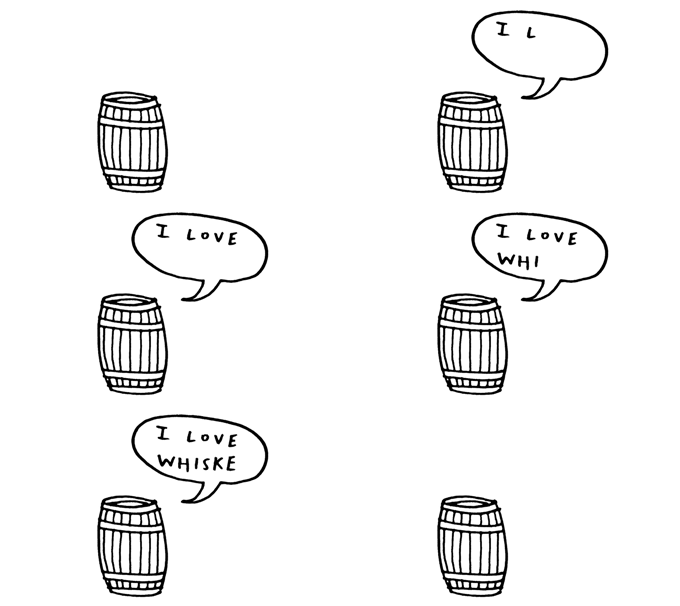
More fun than a barrel full of whiskey.

April 11, 2013 by your friendly neighborhood distillers

There is a lot of myth and conjecture regarding the history and effect of aging whiskey, much of which is just patently untrue, and we are happy to contribute to it.

Before the industrial revolution, wooden casks were the storage vessel of choice; lighter and less fragile than their clay pot cousins, they were produced virtually everywhere by skilled craftsmen known as coopers (obviously named after a popular barrel-colored distillery cat). They were a valuable commodity: they were costly to produce, and a barrel, properly maintained and cared for, could last for generations actually I’m not sure, but a very long time. The down side is that wood is porous, so if you stored your pickled herring in the family barrel, that flavor (and smell) would hang on to the wood for a while. The solution? Fill the emptied barrel with straw, and burn out all that delicious briny fish flavor.

the rent is free but then we drink you

Welcome to your new home, whiskey.


Eventually people discovered that burning the inside of the barrel not only got rid of last week’s catch, but it also altered the flavor of whatever went in to it next. Whiskey, wine, brandy – all of these liquids were carted around in barrels, stored and saved for a rainy day in them, and were accordingly transformed. Over time the color of the liquor changed, and more importantly, so did the flavor.

The question, then, is why? What happens inside the barrels?

Well, a lot of things.

First, and perhaps most importantly, oxygen is slowly introduced to the whiskey. Whiskey is a complex liquid, full of not only ethanol and water, but also phenols, amino acids, esters, aldehydes, and a whole litany of other chemicals (plus tannins, lignins, lactones, cellulose, and other compounds added from the wood – more on this below). Oxygen, well, oxidizes these chemicals, as oxygen is wont to do. This oxidation is what changes their flavor from the new make spirit. This is where the porous nature of the wood comes in to play, because it causes the barrels to “breathe” – as the liquid heats up during the day, it expands into the airy wood; when it cools at night, it withdraws into the barrel, creating a vacuum that draws air (which is about one fifth oxygen) in with it.

Second, and nearly as important, the charred wood itself has a number of effects on the whiskey. In addition to the aforementioned tannins and lignins that are added to the spirit, the expansion and contraction pulls other compounds from the wood. Wood sugars have been caramelized; vanillin has been created in the toasted wood behind the char. It’s important to note that some of these are water soluble, and others are alcohol soluble, so it’s essential to reduce the strength of the distillate between the still and the barrel.* As the liquid flows in and out of the charred oak, the porous char acts like activated charcoal: a high surface area replete with greedy carbon molecules, ready to grab and filter out whatever contaminants they can get their dirty little bonds on.

There are other factors in the aging process, most notably time and barrel size. Regarding the former, a quick glance at any shelf of whiskey will reveal a broad range of ages: zero years, four years, twelve years, thirty years, a billion years, and so on. The reason for this, quite simply, is because taste is subjective. There is no ideal age; there are just differences. Regarding size, most of those bottles are full of whiskey aged in large barrels – 53 gallons or larger (hundreds of gallons or more). Smaller barrels affect the whiskey in a different way. But both of those topics will be addressed at length in a different post.


*higher alcohol is more cost-effective; nobody is interested in bottles of barrel-aged water. As such, the major distilleries tried to get the laws changed to allow a higher proof be put in barrels – 190 or so. In a refreshing turn of events, the government did not allow these huge corporations to sacrifice quality and consumer experience in the interest of profit, and capped the allowed proof at 125 – which most of them use. We, however, use 110-118 proof; slightly less cost-effective, but yielding better results.